

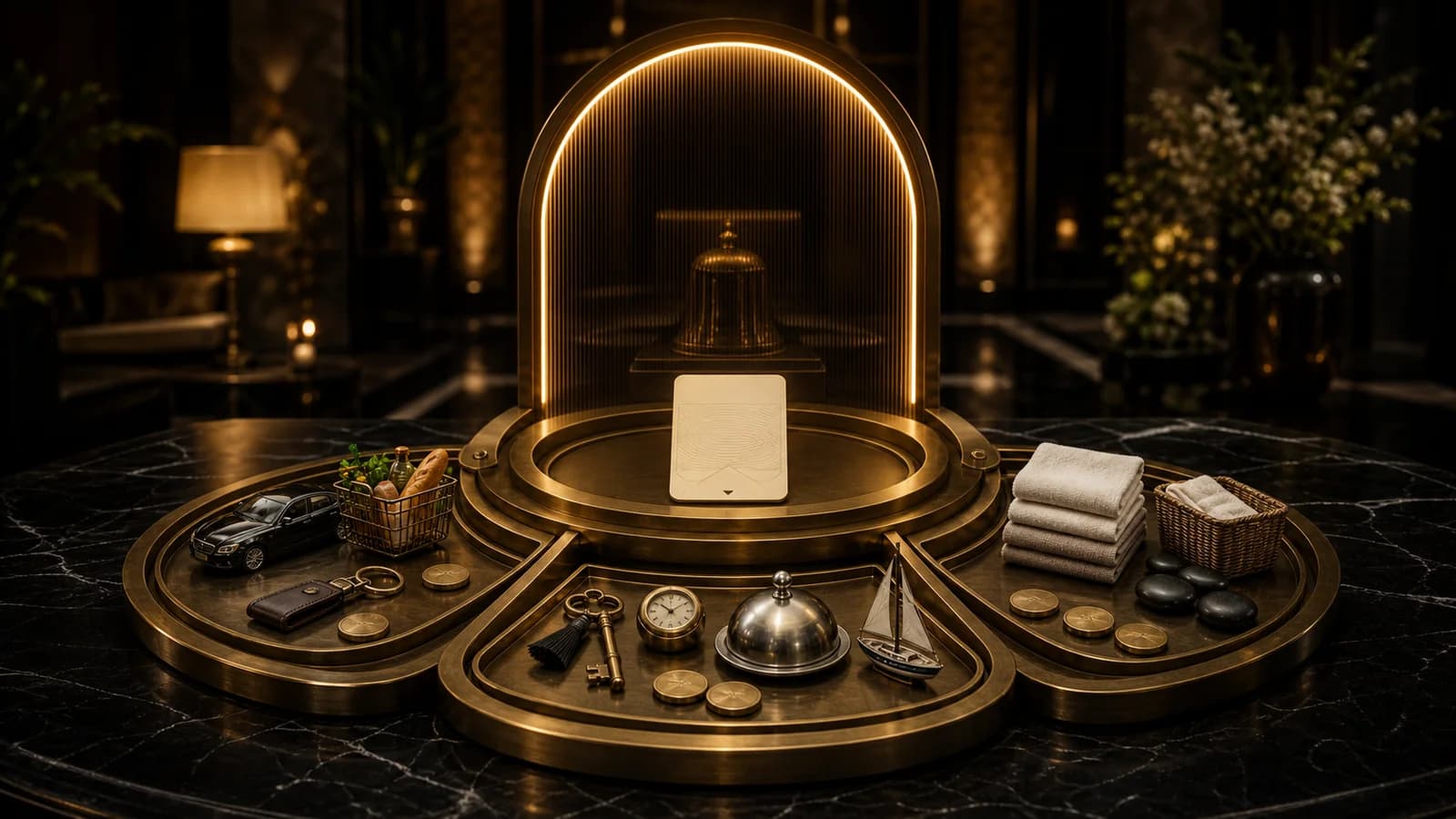
Nine upsells worth offering, laid out as plays: early check-in and late checkout (pure margin, ask before check-in), airport transfer and groceries (pass-through with a coordination fee, ask right after booking), mid-stay clean, breakfast, scooter or car hire, massage, a boat day or tour, and laundry. The rule that matters more than the menu: when you ask beats what you offer. Ask too early and the guest hasn't pictured the trip yet; ask too late and they've improvised their own plan. A portal converts better than a message thread — browsable, priced, no negotiation, working after you've gone to bed. Offer once, never chase — a second nudge reads as pressure and shows up in the review.
The menu of plays
Each of these is a real thing owners sell today, not a hypothetical. What differs is the margin: some cost nothing to deliver and are near-pure profit; others are pass-throughs where you're adding a coordination fee on top of someone else's service. Confusing the two is how owners leave money on the table or overprice something a guest could book directly for less.
1. Early check-in / late checkout
Pure margin, if your cleaner's schedule allows it — you're selling calendar time that would otherwise sit empty. Enso Connect, a guest-experience platform running upsells for vacation rental operators, advertises this pairing at an average $157 per stay across the properties on its system. Price it for turnover risk, not actual cost, because the actual cost is near zero when the calendar has room. Ask at booking confirmation or the week before, not on arrival day — by then the guest has already built a plan around your default time.
2. Airport transfer
Pass-through with a coordination fee: you book a driver, mark it up modestly, and take on the liability if they're late. Remote or island villas (Koh Phangan, Bali, the Amalfi coast) can charge more, since the alternative — arranging transport somewhere unfamiliar — is genuinely worse. Ask the moment a booking confirms, while flight details are fresh.
3. Mid-stay clean
Close to pure margin if your cleaner already services the property regularly — an extra visit, not new capacity. Easy to sell on stays of five nights or longer, once the guest has lived in the mess for a few days. Offering it at booking is pointless; there's no felt need yet. Offer it on day two or three, through a portal message priced and bookable without a reply-and-wait exchange.
4. Chef or in-villa breakfast
Pass-through with a fee, edging toward margin if you employ the cook directly. High-ticket, high-perceived-value — a private breakfast reads as luxury on a modest ingredient cost — so it tolerates a healthier markup than a transfer or grocery run. Offer pre-arrival: chefs need a shopping list and lead time.
5. Groceries pre-stocked
Pass-through with a coordination fee — you're charging for the shopping, not the food. Guests expect this offer; the alternative is landing jet-lagged to an empty fridge with no car. Ask right after booking, with a simple checklist (basics, family, stock-the-bar) rather than an open "let us know what you need," which turns into a back-and-forth that kills the impulse.
6. Scooter or car hire
Pure referral to a local rental shop — a coordination fee or flat referral, with vehicle, fuel and liability staying with the rental company. Offer at booking confirmation for destinations where a vehicle is the difference between seeing the island and staying at the villa. Keep it a link and a price — guests price-check against street-level shops and any friction sends them there.
7. Massage / spa
Pass-through with a commission — a therapist or spa pays for the referral, in the same range as other local-service commissions below. A mid-stay sell: the treat a guest adds once relaxed into the trip, not something they picture while booking. A day-two or day-three portal nudge converts better than a pre-arrival pitch buried among transfer and grocery questions.
8. Boat day or tour
Pass-through with a commission from the operator. Airbnb's own Experiences marketplace takes a 20% commission on bookings through the platform — a useful benchmark for what a tour operator can absorb. The highest-ticket item here, and the one guests research on their own if you don't offer it first, so presenting it priced and bookable captures a sale that was happening anyway. Offer it early — mid-trip is too late to plan around weather and availability.
9. Laundry
Pass-through with a small fee if outsourced, closer to margin if staff handle it in-house. Low-ticket and unglamorous, but reliable on longer stays where guests run out of clean clothes. Mid-stay is the only sensible timing — nobody plans laundry from the booking page.
The single biggest lever: when you ask
Everything above sorts into three timing windows, and putting an upsell in the wrong one is the most common way owners lose a sale they'd otherwise have made. Right after booking, while the trip is still an idea, guests are receptive to logistics — transfers, groceries, vehicle hire, anything removing friction from a plan they're still assembling. In the week or two before arrival, anticipation has built and they'll spend on upgrades, not just friction removal — early check-in, a chef, a tour. Hostaway's own guide puts accommodation at roughly 30% of a typical vacation budget, leaving most of what a guest planned to spend still unspent by the time they land. During the stay, the frame flips again: they're reacting to what they're experiencing, which is why a mid-stay clean, a massage, or laundry land better as an in-stay nudge.
The failure mode in both directions is the same: asking outside the guest's current frame of mind. Pitch a mid-stay clean at booking and it reads as an unwanted fee, since there's no lived mess yet. Pitch groceries on day three and you've already lost the sale to whatever supermarket run they organised out of necessity on arrival day. Match the offer to what the guest is actually thinking about, and the same nine items convert at meaningfully different rates depending only on timing.
Why a portal outsells a message thread
A WhatsApp thread can technically sell all nine of these. In practice it rarely does, for reasons that are structural, not about effort. It's not browsable — the guest has to remember to ask, and most don't. It's not priced up front, so every upsell becomes a negotiation, and negotiations lose momentum the moment the guest has to wait for a reply. It only works while someone's awake, which for an owner across time zones means offers get missed at 2am local time. And it defaults to your language, not the guest's.
A portal reverses all four: browsable on the guest's own schedule, priced so there's nothing to negotiate — a number and a book button, the same shape as any checkout they already know — working while you sleep, and able to present in the guest's own language without you writing a second version of every offer by hand.
That doesn't mean everything belongs there. High-touch requests — a special-occasion arrangement, a complaint, anything depending on details the guest hasn't given you — should stay a conversation; a fixed-price menu handles them badly. The portal is for the nine repeatable items above: known price, known delivery, no judgment call required.
The local-partner side: commission conventions
Every pass-through upsell above depends on a local partner — a driver, a chef, a spa, a tour operator — and what you can reasonably charge follows conventions that already exist in travel, even where nobody in your villa's town has written them down. Tour and activity operators commonly pay referral commissions in the 10–20% range industry-wide, per travel-agent commission data compiled by DMCQuote, with specialised tours sometimes running higher. Airbnb's own Experiences marketplace takes 20% on bookings through its platform — a reference point local operators are already used to being asked for. Restaurants and drivers rarely publish a rate card; a 10–15% arrangement or a flat coordination fee per booking is the practical norm, worth agreeing in writing once rather than renegotiating every time.
The mechanics matter more than the exact percentage: agree the rate before sending guests, not after the first booking; keep a simple log of who you referred and when, since disputes happen and memory isn't evidence; and treat the relationship as reciprocal — a partner getting consistent volume from your villas has a reason to prioritise your guests, worth more over a year than squeezing an extra five points out of the commission.
The honest caution
Upsell pressure damages reviews. A guest who gets a transfer pitch, a grocery pitch, a spa pitch and a tour pitch in the same welcome message reads it as a sales funnel, not hospitality — and that survives into the star rating even when each offer was reasonable alone. The fix isn't to sell less; it's to sell once. Present the relevant items for that stage of the trip, clearly priced, then stop. Don't re-send the massage offer because the guest didn't click it in 48 hours. Don't escalate a soft no into a cheaper version of the same pitch. A guest who wanted the mid-stay clean will ask, or will see it again naturally when they open the portal for something else. Chasing a decline buys a handful of extra sales at the cost of a review line that costs future bookings — a trade that loses on any honest accounting.
See the full pricing
Hostella's guest portal ships with the co-host plan — no separate upsell tool to license or wire up.
View pricingNone of this requires guessing what guests want — matching nine known items to the moment a guest is receptive, pricing pass-throughs honestly instead of hiding the coordination fee, and putting the menu somewhere a guest can browse without asking first.