

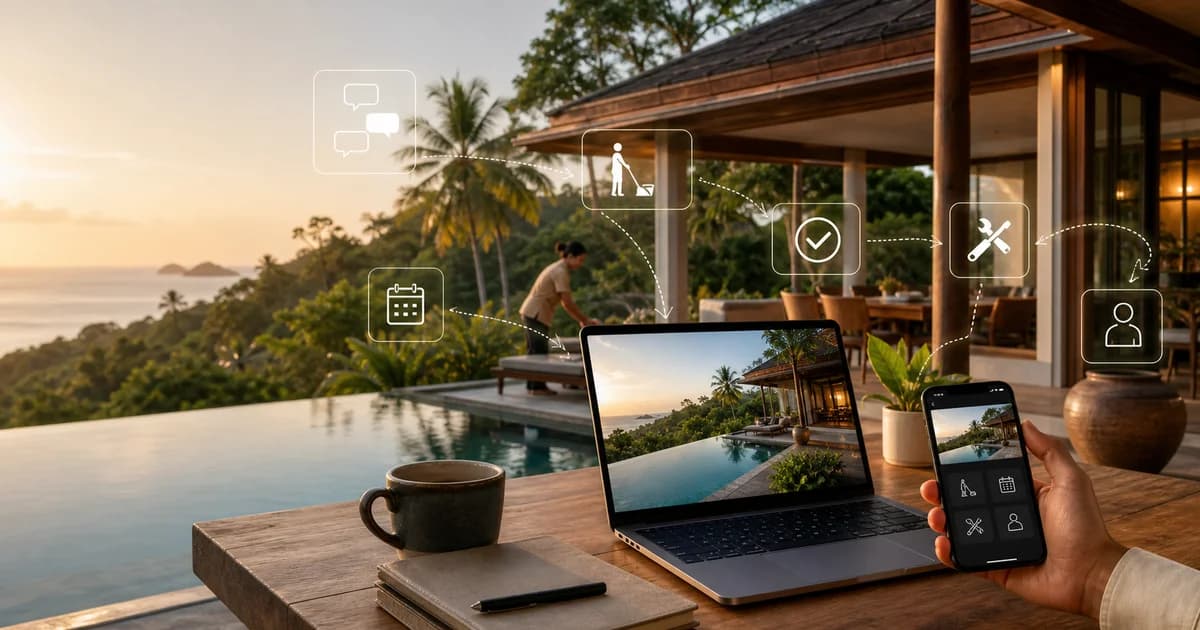
You can run a Thai villa well from Tel Aviv, Berlin or Sydney — operators do it every day — but not by doing remotely what you used to do in person. The job changes shape: your presence gets replaced by a stack (a local keyholder for hands, an AI layer for guest messaging and task dispatch, two-way iCal for calendars) and your role shrinks to judgment calls and relationships. The three things that actually break when you leave are overnight guest messages (timezones make "I'll answer in the morning" a 10-hour delay), staff coordination across languages, and the slow decay you can't see. This playbook covers the stack that fixes each, drawn from operators who've made the move — including one who runs Koh Phangan villas from the other side of the world.
The moment usually arrives with a life change: a family move, a new job, a return home after years on the island. The villa stays; you don't. The first instinct — hand everything to a full-service manager for 20–28% of revenue — is the expensive default, and for owners who built a brand guests come back for, it often means watching that brand dilute. The alternative isn't heroic long-distance micromanagement. It's building the operation so it doesn't need you in the room.
What actually breaks when you leave
Three failure modes account for most of the damage. First, the timezone gap: a guest messaging at 22:00 Thailand time reaches you at afternoon coffee in Europe — fine; a guest messaging at 05:00 Thailand time about a 07:00 airport transfer hits you asleep, and the OTA response clock keeps ticking. Second, staff coordination: instructions that once took a 30-second face-to-face now travel as voice notes across a language barrier, and 'the pool guy came?' becomes genuinely unknowable. Third, invisible decay: the sun-bleached cushion, the dripping tap, the garden edging that slipped — things a walkthrough catches in minutes accumulate silently until a review says 'tired'.
The remote stack: people, process, software
Staff coordination across languages
On Koh Phangan and Samui, your housekeeping and maintenance team likely works in Thai or Burmese, while you and your guests work in English, Hebrew, German. The old solution was a bilingual manager as human router — a single point of failure with a salary. The working solution is tooling that speaks everyone's language natively: guest requests arrive in English, the cleaner sees the task in Thai or Burmese in a staff app, and completion flows back without anyone translating anyone. (This exact gap — a Thai-village team and a foreign owner — is why Hostella's staff app ships in English, Thai and Burmese.) The human relationship still matters: pay on time, visit when you can, remember families. Tools coordinate work; they don't replace being a decent person to work for.
The regulatory caveats (take these seriously)
Not legal advice, and Thailand's rules genuinely require local counsel: short-term rental of houses and villas intersects with the Hotel Act and its ministerial exemptions (registration matters), TM30 reporting of foreign guests is the owner's obligation and enforcement varies by province, foreign ownership structures affect what you may legally operate, and income earned in Thailand is taxable there regardless of where you live. Remote operation makes compliance easier to forget and no easier to excuse — one hour with a Thai property lawyer before you leave is the cheapest insurance in this entire playbook.
A week in the life, done right
What good looks like after the stack is in place: Monday you skim the weekend's guest threads — the AI handled the check-ins, the airport transfer at dawn, a pool-towel restock dispatched and closed; you approve one draft about a partial-refund request. Wednesday the photo walkthrough lands; you flag one cushion and it becomes a task. Friday you check occupancy for next month and nudge pricing on two soft weekends. Total operator time: perhaps 90 minutes, at hours you chose, none of them 4am. The villa didn't notice you're 8,000 kilometres away — and neither did the guests.
Built for exactly this operator
AI guest messaging around the clock, staff tasks in your team's language, calendars in sync — run from any timezone. And if you'd rather have it set up for you, our studio does that.
See services