

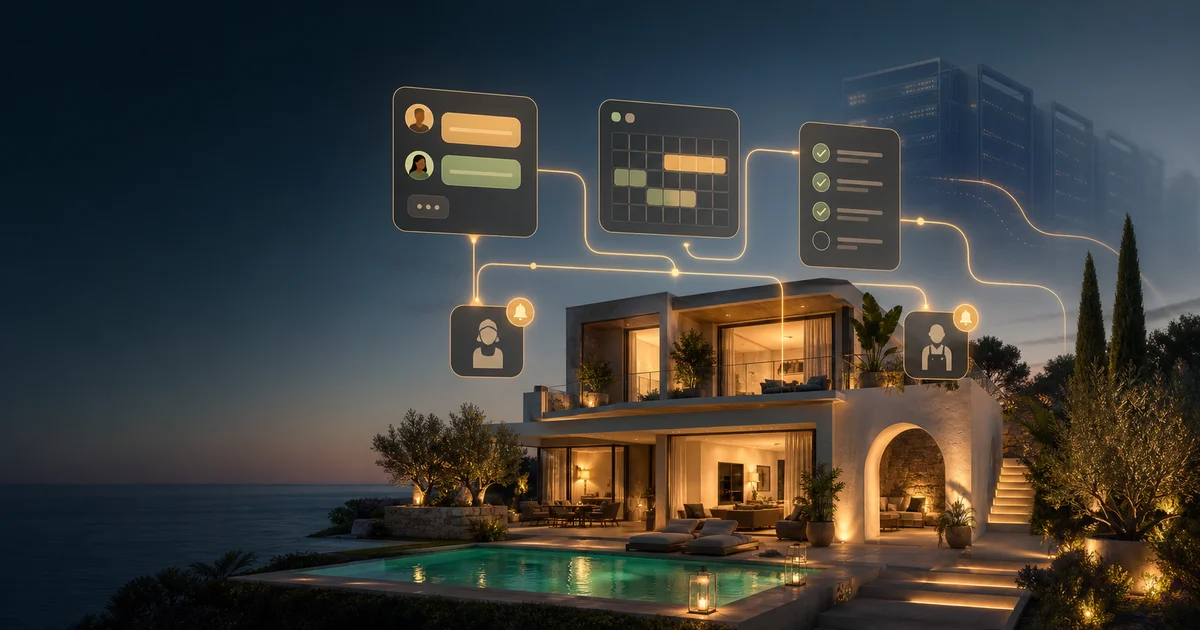
For most operators under about 20 villas, no — you do not need a property-management system to automate the work that is actually drowning you. Guest messaging, staff tasks and calendar sync all run PMS-free: two-way iCal keeps calendars aligned, an AI co-host answers guests and turns requests into assigned tasks, and OTA messages flow into one inbox. A PMS earns its keep when rates-and-reports become daily work — multi-OTA rate management, trust accounting, owner statements — which usually happens at portfolio scale. This guide gives you a five-question test, shows what a PMS-free stack looks like at 1, 5 and 20 villas, and is honest about when a PMS is exactly the right call.
Go shopping for "Airbnb automation" in 2026 and you will notice something odd: almost every tool's setup starts with "Step 1 — connect your PMS." AI messaging tools, upsell tools, review tools, guest-experience apps — the assumption everywhere is that you already run a property-management system, and the automation layer just plugs into it. For a professional manager with 80 listings that assumption is fair. For the owner of two villas in Koh Samui, it is like being told to install an ERP so you can answer email.
The adoption numbers hide this split. Hostaway's 2026 Short-Term Rental Report found 60.7% of operators already using AI in daily operations, rising to nearly 80% among managers of 51+ properties. The big end of the market automates through a PMS because it already has one. The small end is being sold the same architecture whether it needs it or not — and a PMS subscription, migration and learning curve is a steep tax to pay just to get your messages answered at 2am.
What a PMS actually does (and what it doesn't)
A property-management system is the system of record for a rental business: reservations, rates, availability, payments and owner reporting live in one database and get pushed out to every connected OTA. That is genuinely valuable — when you have enough properties and channels for it to matter. The core PMS jobs are multi-OTA rate and availability management (different prices per channel, updated daily), trust accounting and owner statements (you manage other people's properties and owe them clean monthly reports), a direct-booking engine with payment processing, and portfolio-level reporting.
Notice what is not on that list: answering guests, dispatching your cleaner, remembering that villa 3's pool pump trips the breaker. The day-to-day operational load — the thing that actually burns hosts out — is not what a PMS does. Even on a PMS, those jobs come from add-on tools or people. Published entry pricing for the popular systems runs roughly $20–$40 per listing per month (Guesty from $27, Lodgify from $12, Hostaway by sales quote), before the add-ons that handle guests and staff.
The five-question test
Whether you need a PMS is not about how modern your operation is. It is about whether the system-of-record problems are real for you. Five questions settle it.
Score it honestly. Zero or one "yes" on questions 1–4: you do not need a PMS yet, and everything in the next section runs without one. Two or more: get a PMS — a good one — and put the AI layer on top of it. And if question 5 is where you nodded hardest, notice that it is the one question a PMS was never designed to answer.
What you can automate with zero PMS
The PMS-free stack covers the entire guest-and-staff side of the business. Guest messaging: an AI co-host answers in the guest's language, from your villa's own rules and reservation context — and acts on what it hears, opening a task for the cleaner or maintenance and tracking it to done. Staff operations: requests become assigned tasks with SLA timers instead of forwarded screenshots. Calendars: two-way iCal sync keeps Airbnb, Booking.com and your own bookings aligned — the same mechanism a channel manager uses for availability, without the rest of the machinery. Channels: WhatsApp, Telegram and a per-guest web app run fully two-way; OTA messages flow into the same inbox with AI-drafted replies (native auto-send on the OTAs is still rolling out across the industry — be suspicious of anyone claiming otherwise).
The math is the pleasant surprise. Five villas on Hostella's Manager tier cost €39 plus €25 per villa — €164 a month, about €33 per villa, with no PMS line item underneath it. The typical alternative is $20–$40 per listing for the PMS plus a separate messaging add-on on top. For small portfolios, skipping the system of record is not a compromise; it is simply the right-sized architecture.
When a PMS is exactly the right call
Honesty cuts both ways. Past roughly 20 units — or the moment you manage properties you do not own — the system-of-record problems stop being theoretical. Per-channel rate strategy across three or four OTAs is real revenue. Owner statements assembled by hand are an error factory. Direct bookings need a checkout with payment processing, not a bank-transfer conversation. At that point Guesty, Hostaway and their peers are the professional answer, and pretending iCal covers it would be malpractice.
The key is that this is not either/or. The pattern that wins in 2026 is PMS as system of record, AI layer as front desk — Hostaway themselves launched an "AI CoHost" this year, which tells you where the market is going. Hostella runs on either side of that line: PMS-free on iCal and direct channels for small portfolios, or connected through its Hostaway connector when you already run one — reservations, calendar and guest messages sync into the same unified inbox, and Hostaway stays the system of record. You never migrate; you add the layer that was missing.
Three stacks, sized honestly
Price the no-PMS stack for your portfolio
Solo is €29/month for one villa; portfolio tiers start at €25 per villa. 14-day free trial, no credit card — and no PMS required underneath.
See Hostella pricingThe test, in the end, is pain-shaped rather than size-shaped. If your evenings disappear into rate grids and owner reports, buy the system of record. If they disappear into guest messages and staff coordination, that is not a PMS problem and never was — automate the front desk first, and let the PMS wait until the numbers demand it.