

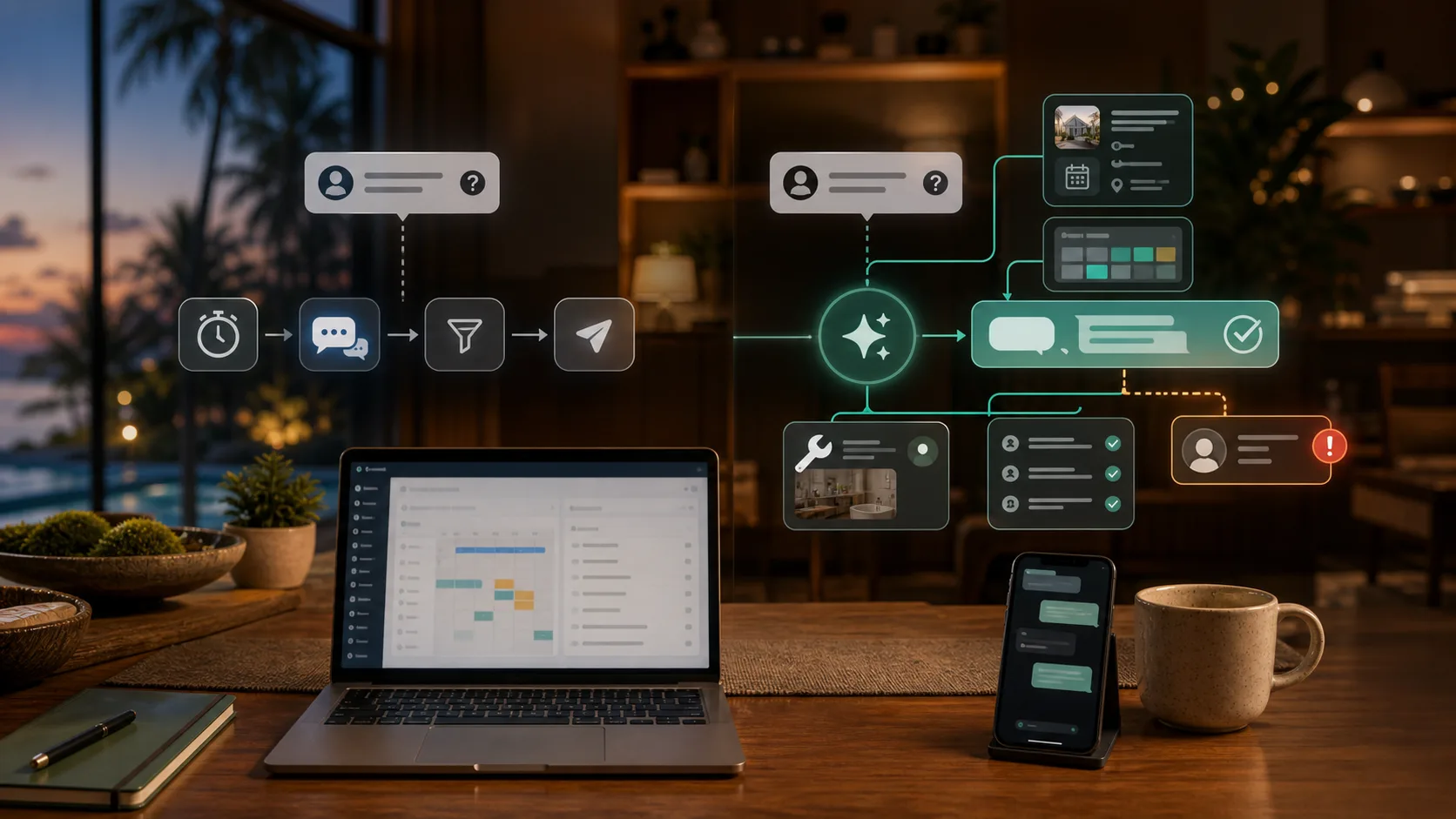
"Airbnb automation" covers four very different things. Saved replies and scheduled messages send the same text to everyone on a timer. Keyword bots match a word and fire a canned answer. A real AI agent reads the whole thread, understands context, drafts in your voice, opens and routes staff tasks, and escalates the cases that need judgment. Simple auto-reply is genuinely enough for a single listing with predictable questions and a host who is usually awake. You need an agent when volume, time zones, languages, or staff coordination outgrow what one person can hold in their head — roughly 70% of routine guest needs can run autonomously, while about 30% still belong with a human.
Almost every host says they have "automated" their Airbnb messaging. Almost none of them mean the same thing. One host means three saved replies they paste by hand. Another means scheduled check-in instructions. A third means a bot that fires a Wi-Fi code when it sees the word "wifi." A fourth means a system that reads a complaint, drafts a reply in their tone, opens a maintenance task for the right worker, and pings them only when money is involved. These are not points on one ladder so much as four genuinely different tools — and most of the confusion in the market comes from calling all of them "AI."
This guide draws the line clearly. We will walk the spectrum from the built-in Airbnb tools through keyword bots to a real agent, say honestly where each one is the right answer, and give you a simple test for which tier your operation actually needs. The goal is not to talk you into the most expensive option. For a lot of hosts, the free built-in feature is the correct choice — and we will tell you when.
The four tiers of Airbnb message automation
Tier 1 — Saved replies and scheduled messages (what Airbnb gives you)
Airbnb ships two native features. Saved Messages (or "quick replies") are templates you insert by hand into a thread, with a few merge fields like the guest's first name or check-in date. Scheduled Messages send a fixed template automatically at a fixed trigger — booking confirmed, day before check-in, morning of check-out. That is the whole capability. It is text you wrote in advance, delivered either by your click or by a timer.
This is not a knock. Scheduled messages are one of the highest-leverage things a small host can set up, and they cost nothing. Check-in directions the night before, the door code on arrival morning, a check-out reminder, a review nudge after departure — these are predictable, low-risk, and don't need to understand anything. They just need to arrive on time.
Tier 2 — Keyword and rule bots
The next tier up, sold by various third-party tools, matches words in an incoming message and fires a pre-written response. Guest types "wifi" → bot sends the network and password. Guest types "check in" → bot sends the arrival block. It feels smart the first time you see it. It breaks the moment a guest writes the way humans actually write: "Hey, we land late and the wifi on the listing didn't work last time — can someone check before we arrive?" That single message contains a late check-in, a Wi-Fi complaint, and a request for a staff action. A keyword bot sees "wifi," sends the password, and ignores the other two-thirds of the message.
A keyword bot answers the word it matched. A guest wrote a sentence. The gap between those two things is where bad reviews come from.
Tier 3 — A real AI agent
An AI agent reads the entire message — and the thread behind it, and the reservation context, and your house rules — and responds to what the guest actually meant. It can hold three intents in one message, answer in the guest's language, and decide whether a reply is enough or whether something needs to happen in the physical world. That last part is the real dividing line. Saved replies and keyword bots only ever produce text. An agent can produce text and an action: it turns "the AC isn't cooling" into a maintenance task, routes it to the right worker with an SLA timer, and confirms back to the guest — without anyone re-typing anything. And it knows when to stop and ask you first.
Tier 4 — Where it goes from here
Be skeptical of anyone claiming a fully autonomous, no-human operation today. The honest state of the art is a human-in-the-loop agent: it handles the routine end to end, prepares the hard cases with full context, and keeps a person in the chair for judgment calls. The trajectory is toward more autonomy as the agent earns trust on your specific property — but "earns" is the operative word, and the human gate on money and complaints is a feature, not a limitation to be removed.
Side by side
When simple auto-reply is genuinely enough
Plenty of hosts do not need an agent, and we would rather say so than sell you one. Stick with Airbnb's built-in saved and scheduled messages if most of the following are true:
- You run one or two listings, not a growing portfolio.
- Your inquiries are predictable — directions, Wi-Fi, check-in time — and rarely compound.
- You and your guests share a language and you only sell on Airbnb.
- You're usually awake and reachable when your guests are.
- There's no staff to coordinate — you are the cleaner, the fixer, and the host.
If that's you, set up three or four scheduled messages, write a handful of saved replies for the questions you answer most, and put your money elsewhere. Automation should remove a chore, not add a subscription.
When you've outgrown it
The signs you need a real agent are operational, not technological. You notice them as friction, not as a missing feature:
- Guests message in languages you don't speak, and your translations come out robotic.
- Overnight inquiries from other time zones sit unanswered until morning — and the booking goes to whoever replied first.
- A guest reports a broken appliance and you become the relay between them and your handyman, re-typing the same thing twice.
- You're across three or four channels — Airbnb, Booking, WhatsApp, the guest's email — and the conversation is scattered.
- New staff can't be trained because nothing is written down and there's no task history.
- You've started declining bookings or growth because the messaging load is the bottleneck.
None of these are fixed by a better template. They're fixed by something that understands context and can act — which is the definition of an agent, not an auto-reply.
Not another inbox — an agent that answers, acts, and escalates
Hostella sits on top of the stack you already use — your channel manager, your PMS, your VA. It drafts replies in your voice, turns requests into routed staff tasks, syncs your calendars, and hands you only what truly needs a human.
See how it worksWhat an agent honestly is — and isn't
Two clarifications, because the category is full of overstatement. First, an AI agent is not a full property management system. Hostella, for example, sits on top of your existing stack rather than replacing it — keep your channel manager, your PMS or vacation-rental software, and your VA; the agent handles the guest conversation and the work that flows out of it. Second, on the messaging side, the channels are not all equal yet. WhatsApp and Telegram are fully two-way today. Airbnb, Booking.com and Agoda messages flow into a unified inbox and the agent drafts the reply — but automatic sending on those OTAs is still rolling out, so for now you approve the OTA reply with a tap. That's the honest picture, and it's worth knowing before you choose a tier.
The reason staged autonomy matters is trust. A good agent doesn't start on autopilot — it starts in a learning mode where every reply is a draft you approve or correct, then earns auto-send on the safe categories as it absorbs your wording. The money, the complaints, the 2am lockout on a 38°C night: those keep routing to you with full context and a suggested reply, indefinitely. That isn't the agent failing to be autonomous. It's the agent knowing the difference between a Wi-Fi password and a refund — which is exactly the difference a keyword bot can't see.
So: "Airbnb auto-reply" and "a real AI agent" are not better and worse versions of the same product. They solve different problems. If your messaging is predictable and you're the whole team, the built-in scheduled messages are the right answer and they're free. The moment context, languages, channels, or staff coordination outgrow one person's working memory, you've crossed into agent territory — and no amount of saved replies will carry you across it.